Refractory Castable & Insulating Castable Supplier in Indonesia
Not every part of a furnace can be bricked. Complex shapes, burner blocks, roofs and frequently changed areas are more practical to line with monolithic material — castable cast in place. Add ceramic fibre for lightweight insulation, and this combination gives a tight, energy-saving, fast-to-install lining.
We supply dense and lightweight castables, refractory mortar, ceramic fibre blanket/module and plastic refractory for high-temperature process industries. For a full breakdown of castable types, temperature classes and installation steps, see the castable refractory guide sections below.
Products we supply
- Conventional dense castable — high-alumina for working linings that resist abrasion and high temperature.
- Low-cement & ultra-low-cement castable (LCC/ULCC) — higher strength and chemical resistance for critical applications.
- Lightweight insulating castable — low density for back-up layers and energy saving.
- Ceramic fibre — blanket, board, module and paper up to 1,260–1,430°C for insulation and expansion joints.
- Mortar & plastic refractory — for brick installation and local patching repairs.
Types of Castable Refractory
Not all castable is the same product wearing different labels — cement content, aggregate grade and density change how it performs and where it belongs in a lining.
- Conventional dense castable — 15–25% calcium-aluminate cement with high-alumina aggregate. Good general-purpose strength and abrasion resistance, rated up to roughly 1,300–1,425°C.
- Low-cement castable (LCC) & ultra-low-cement (ULCC) — reduced cement content with microsilica additives gives higher cold crushing strength, lower porosity and better resistance to slag and chemical attack, typically rated 1,500–1,700°C.
- High-alumina & corundum-spinel castable — 80%+ Al₂O₃ or fused-corundum aggregate for the most severe duty zones, up to roughly 1,800°C.
- Plastic refractory & ramming mix — a stiffer, pre-mixed monolithic for hand-ramming into awkward patch repairs and joints, without the water-ratio control that pour castable needs.
Insulating Castable Refractory
Insulating castable is a separate family built around lightweight aggregate (expanded clay, perlite or hollow alumina spheres) instead of dense grog. Bulk density drops to roughly 0.4–0.9 g/cm³ against 2.0–3.1 g/cm³ for dense castable, and thermal conductivity falls with it — that is the point. It is not chosen for strength or abrasion resistance but so less heat escapes through the shell. It is normally cast as a back-up layer behind a dense hot-face lining, or used alone in lower-temperature ducting, kiln cars and burner-block surrounds. Pair it with dense castable or ceramic fibre once process temperature exceeds its own limit — the product range above covers ceramic fibre, mortar and the full material family this product sits within.
Working Temperature Classes
Selection starts with the maximum service temperature the lining will see continuously, not just during upset conditions. As a rough class guide across the products above:
| Castable type | Max. temperature | Bulk density | Typical application |
|---|---|---|---|
| Insulating castable | up to ~1,300°C | 0.4–0.9 g/cm³ | Back-up insulation, boiler casing, duct and kiln-car linings |
| Conventional dense castable | up to ~1,425°C | 2.0–2.3 g/cm³ | General furnace/kiln hot face, ladle preheaters, flue linings |
| High-alumina dense castable | up to ~1,600°C | 2.3–2.6 g/cm³ | Cement kiln burner zone, incinerator hot face, reheating furnaces |
| Low-cement castable (LCC/ULCC) | up to ~1,700°C | 2.6–2.9 g/cm³ | Ladle and tundish lining, high-abrasion metallurgy zones |
| Corundum-spinel / ultra-high-alumina | up to ~1,800°C | 2.7–3.1 g/cm³ | Severe-duty smelter and power-plant boiler zones |
Treat these figures as a starting class guide, not a substitute for the data sheet — request it for your shortlisted grade so cold crushing strength and thermal conductivity are confirmed against your actual operating window before ordering.
Selecting Castable by Temperature and Chemistry
Two questions decide the grade. First, the continuous service temperature including any start-up peak — under-specifying by one class shortens lining life sharply. Second, what touches the lining: acidic flue gas, alkaline cement dust, molten metal or slag, and abrasive particulate each call for different chemistry. High-alumina and corundum-based castable resist most industrial slags; silica-based or fireclay-bonded products are cheaper but vulnerable to alkali attack, which matters for cement and waste-to-energy plants specifically. Where abrasion and chemical attack combine — ladle trunnion areas, for example — LCC/ULCC with silicon-carbide addition is usually specified over conventional dense castable, since unplanned relining costs far more than the material difference.
Installation: Mixing, Vibration Casting & Dry-Out
Castable performance is decided as much by installation as by the bag itself. Water addition must sit within the manufacturer's stated range — excess water lowers final strength, too little leaves voids. The mix is poured or rammed into formwork and vibrated to release entrained air and compact fully against anchors, then cured damp for 16–24 hours before formwork strike. The dry-out schedule that follows is not optional: bound water must be driven off gradually — a common curve holds around 110°C for several hours per 25mm of thickness, then ramps up slowly (roughly 20–25°C per hour) to operating temperature. Heating too fast traps steam pressure and causes explosive spalling, the most common cause of premature castable failure. We supply a mixing, curing and dry-out schedule with every order, matched to section thickness.
Packaging, Supply & MOQ
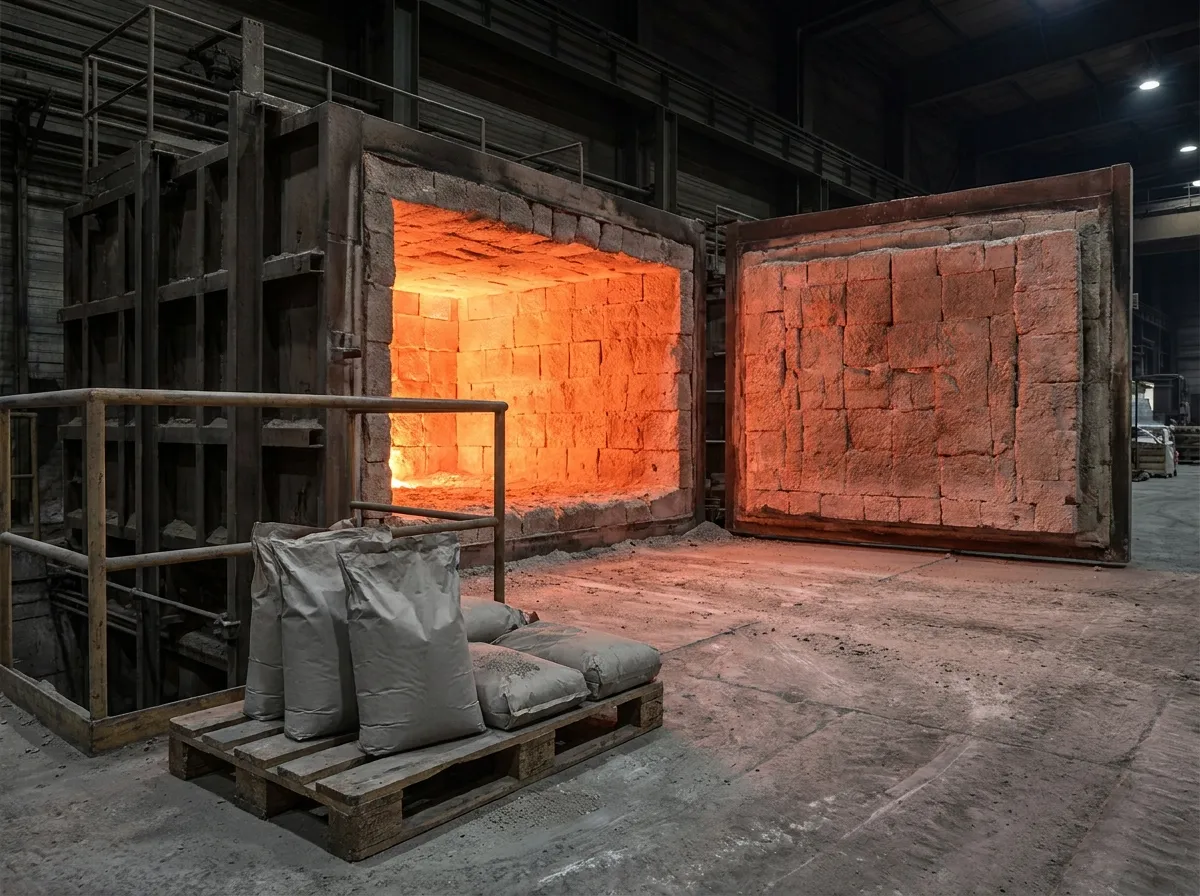
Castable refractory ships in 25kg multi-wall, moisture-barrier bags, palletised, each marked with grade, maximum service temperature and batch number. Common dense and insulating grades are held in stock for smaller relining jobs and urgent repairs; low-cement and high-alumina specialty grades are ordered against project volume, typically 3–6 weeks from confirmed specification. There is no fixed minimum for stocked grades — a few bags for a patch repair is fine — while specialty grades are more efficiently ordered by pallet once your lining area and thickness are confirmed. Send your dimensions by section and we will return a bag count, pallet quantity and lead-time estimate.
Specifications & packaging
Castable is packed in 25 kg bags with maximum service temperature, bulk density and CCS data. Ceramic fibre comes in 96–160 kg/m³ density and 13–50 mm thickness. We help calculate volume requirements from your lining dimensions.
Applications by industry
Steel & foundry: runners, troughs and burner blocks. Cement: kiln inlets and cyclones. Petrochemical: heater linings and ceramic-fibre expansion joints. Power plants: boiler linings. Often combined with refractory bricks as a complete system.
Sourcing & lead time
Common castables and ceramic fibre are stocked for 3–10 working-day delivery; special grades are imported in 3–6 weeks. For large relining, delivery is scheduled to the shutdown timeline.
Quality assurance
Factory data sheets and installation guidance (mixing, curing, dry-out) are included so the lining reaches optimal strength.
Indicative pricing
The figures below are indicative — please request the catalog; price depends on grade, density and quantity.
| Product | Grade | Indicative price |
|---|---|---|
| Dense castable (25 kg bag) | High-alumina | IDR 180,000 – 450,000 |
| LCC/ULCC castable (25 kg bag) | Low-cement | IDR 350,000 – 800,000 |
| Ceramic fibre blanket (per roll) | 128 kg/m³ | IDR 1,200,000 – 3,000,000 |
| Refractory mortar (25 kg bag) | High-alumina | IDR 150,000 – 320,000 |
Contract procurement is on the pricing page. Delivery to smelters and process plants such as Gresik and Balikpapan.